
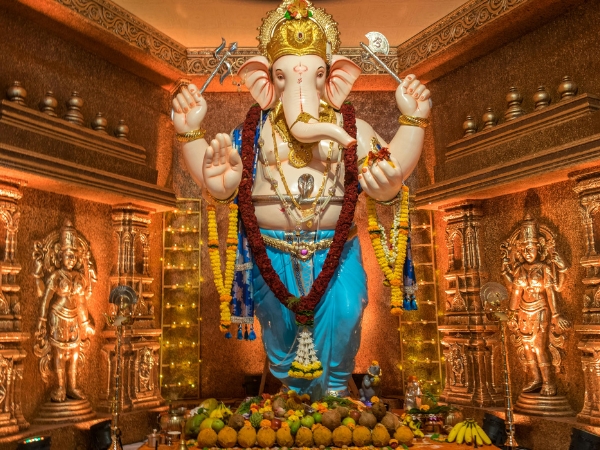
No festival transforms Mumbai quite like Ganpati. For eleven days, entire neighbourhoods reorganise themselves around towering idols, all-night queues, dhol-tasha processions, and a citywide sense of collective devotion that first-time visitors often describe as unlike anything else they've experienced in India. Here's what the festival actually looks like day to day, and where to go if you only have time for a handful of pandals.
Why 11 Days?
Ganesh Chaturthi marks the birth of Lord Ganesha and runs from Chaturthi (the fourth day of the lunar month) to Anant Chaturdashi, when the idol is ceremonially immersed in water — symbolising Ganesha's journey back to Mount Kailash. In 2026, the festival runs from Monday, 14 September to Anant Chaturdashi on Friday, 25 September. Because the dates follow the lunar calendar, they shift every year — always check the current year's exact dates rather than relying on last year's.
What Actually Happens Over 11 Days
- Day 1 (Sthapana): The idol is ceremonially installed at home or at the community pandal, accompanied by Prana Pratishtha (a ritual invoking life into the idol) and the first aarti.
- Days 2–10: Daily aartis (typically morning and evening, with some pandals adding an afternoon session), modak offerings, bhajans, and a steady stream of visitors. Many of the biggest community pandals stay open through the night to manage the crowds.
- Final day (Anant Chaturdashi): The visarjan (immersion) — processions carry idols through the streets, accompanied by dhol-tasha troupes and dancing crowds, ending at the sea or a designated water body. For the biggest pandals, this procession alone can take the better part of a day.
The Best Pandals to Visit
Lalbaugcha Raja (Lalbaug, Parel)
Mumbai's single most iconic Ganpati — and its most crowded, by a wide margin. Over 1.5–2 million devotees are estimated to visit daily during the festival. There are two queues: the Navsachi Line, a slow-moving line for devotees seeking to touch the idol's feet, which can take 18–24 hours; and a faster general darshan line. The idol's final immersion procession heads to Girgaon Chowpatty and can take close to a full day from start to finish. Bollywood stars and political figures are regular visitors here every year. Tip: Go very early morning or late at night if you want any chance of a shorter wait, and carry cash — many stalls nearby don't accept cards.
Ganesh Galli / Mumbaicha Raja (Lalbaug)
Organised by the Lalbaug Sarvajanik Utsav Mandal since 1928, this pandal sits close to Lalbaugcha Raja and is known for elaborate, fully-changing annual themes — in 1977 it made headlines with a 22-foot idol, a first at the time. Aartis are typically held three times a day.
Chinchpokli Cha Chintamani (Chinchpokli)
One of the oldest pandals in the city, dating to 1920. Renowned specifically for the artistry of its idol rather than scale or spectacle — a favourite stop for photographers.
GSB Seva Mandal (King's Circle, Matunga)
Widely known as Mumbai's "richest" Ganpati — the idol is decorated with over 60 kg of gold and hundreds of kilos of silver ornaments, insured for several hundred crore rupees. Founded in 1954 by the Gowd Saraswat Brahmin community, it follows authentic South Indian Vedic rituals rather than the louder, music-heavy celebrations found elsewhere, and uses traditional instruments instead of recorded music. The idol is installed for only five days, which makes the crowds especially intense during that window. Tip: An elevated walkway is set up specifically to help manage viewing crowds — use it rather than pushing toward ground level.
Andhericha Raja (Andheri)
Established in 1966 by workers of the Golden Tobacco Company, this pandal is known for one unusual tradition: instead of immersing on Anant Chaturdashi like everyone else, the idol is immersed five days later, on Sankashti Chaturthi — a practice begun in 1975 at local workers' request so the festival's spirit could extend a little longer.
Practical Tips for Pandal-Hopping
- Carry cash. Most stalls and smaller vendors around pandals don't accept cards.
- Plan your commute around peak visiting hours — evenings get intensely crowded at the major pandals, and roads around Lalbaug and King's Circle see heavy restrictions during the festival's final days.
- Wear comfortable footwear. Queues at the bigger pandals genuinely involve hours of standing.
- If you want the full experience but limited time, prioritise one "grand scale" pandal (Lalbaugcha Raja or GSB) and one "quieter, artistic" pandal (Chinchpokli Cha Chintamani) rather than trying to cover five in one evening — the contrast is worth more than the checklist.
- The immersion days (especially Anant Chaturdashi) bring major citywide traffic disruption — if you're not going specifically to watch a procession, plan to avoid South Mumbai and Lalbaug entirely on that day.
A Festival Best Experienced, Not Just Watched
However you plan your visit, Ganpati in Mumbai rewards showing up rather than reading about it — the scale of devotion at Lalbaugcha Raja and the quiet intensity at GSB Seva Mandal are both things that photographs undersell. Pick two or three pandals, go with time to spare, and let the crowd carry you along rather than fighting it.
We update pandal timings and exact 2026 dates as they're officially confirmed closer to the festival — bookmark this page and check back in late August.